Mainland vs Free Zone in Dubai: What’s the Real Difference?
12/2/2025
One of the first decisions entrepreneurs must make when setting up a business in Dubai is whether to choose a Mainland license or a Free Zone structure. Both offer unique advantages, but the right choice depends entirely on how the business will operate, generate revenue, and scale.
Understanding the practical differences — not just the marketing highlights — is essential for avoiding costly restructuring later on.
Operational Scope: Where You Can Do Business
The core distinction between Mainland and Free Zone companies lies in where they can conduct business.
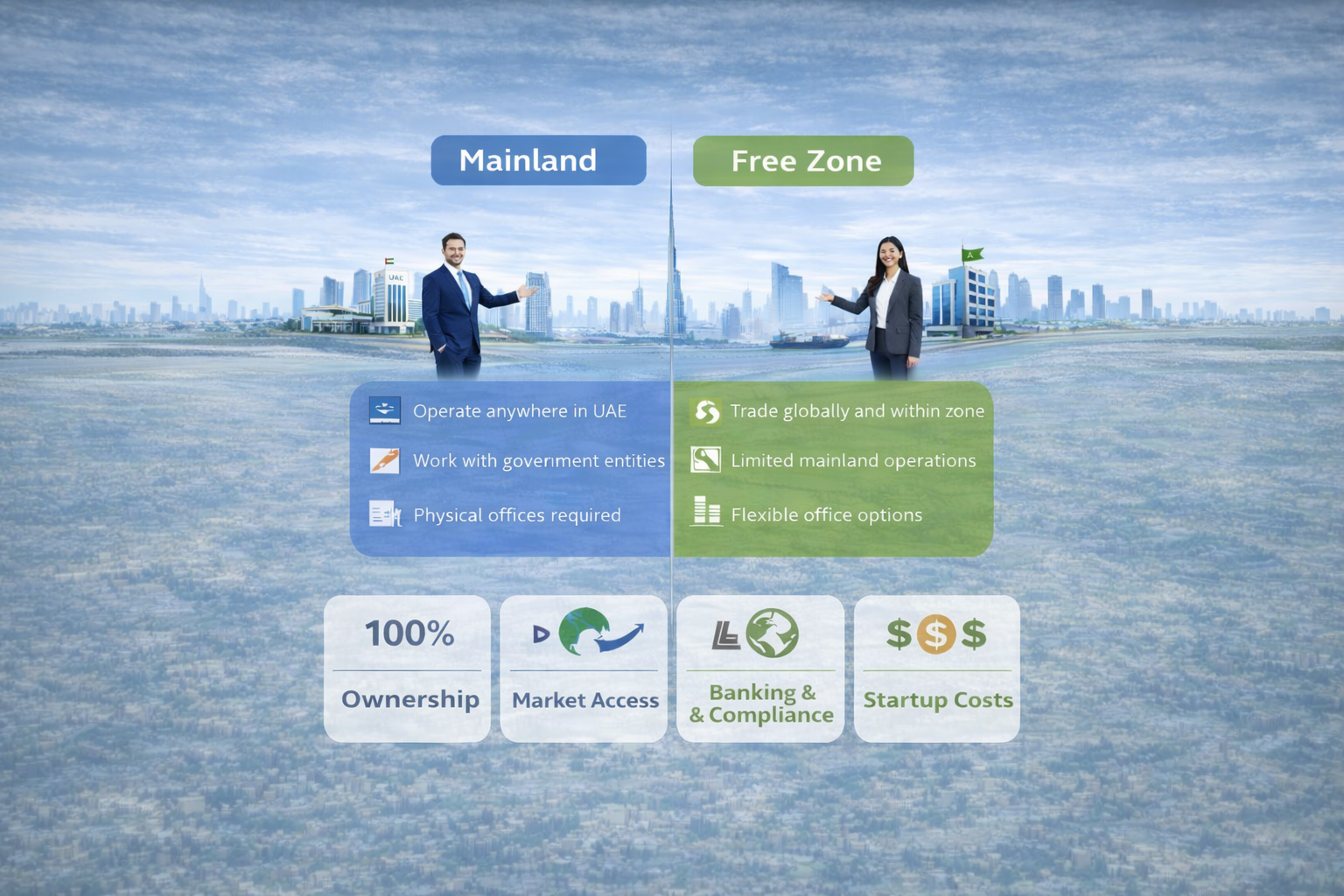
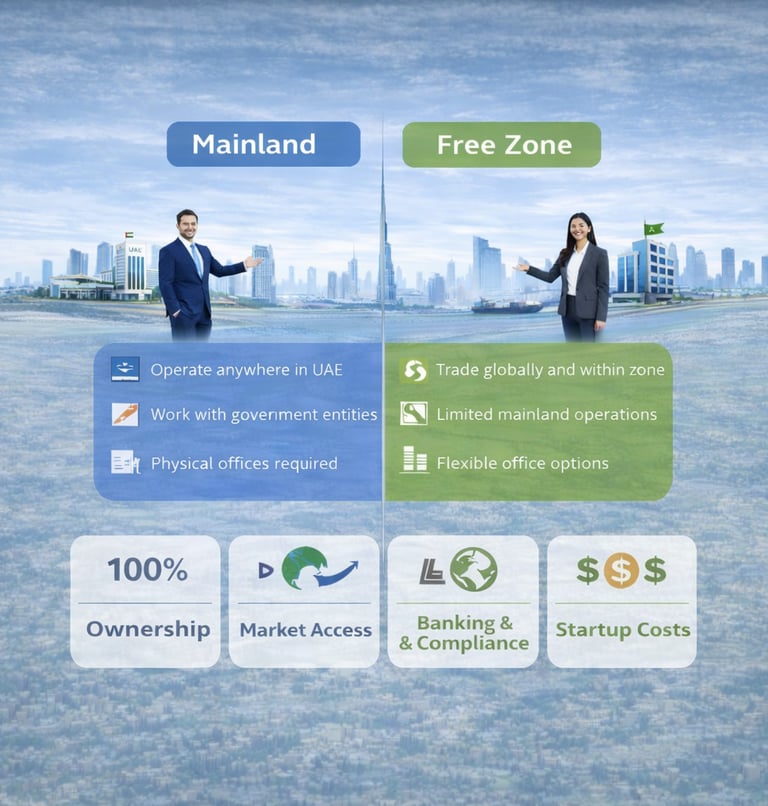
A Mainland company can operate anywhere in the UAE as well as internationally. It can serve clients directly onshore, work with government entities, and open offices freely across different emirates. This flexibility is essential for businesses that require on-the-ground presence, such as consulting firms, retail operations, logistics providers, or service-based businesses targeting UAE residents and companies.
Free Zone companies, on the other hand, are designed primarily for international or free-zone-based activities. They can trade globally and operate within their specific zone, but they cannot conduct direct business on the UAE Mainland without using a distributor, establishing a branch, or complying with special rules. For many digital, remote, or international businesses, this limitation is completely manageable. For others, it can be a growth barrier.
Ownership and Corporate Structure
Both Mainland and Free Zone companies offer 100% foreign ownership across most activities. However, some Mainland activities — particularly those considered strategic — may still require external approvals. Free Zones, by contrast, guarantee full ownership without exception, which appeals to foreign investors seeking simplicity.
Office Requirements and Substance
Mainland companies require a physical office space. The size can vary based on the number of visas needed and the nature of the activity, but physical presence is mandatory. While this adds cost, it also enhances credibility with banks and supports compliance requirements.
Free Zones often allow flexible options such as shared desks, coworking spaces, or virtual office packages. Although cost-efficient, these lighter structures may create challenges when opening a corporate bank account, as banks increasingly require evidence of business substance.
Banking Considerations
Banking is a determining factor for many founders.
Mainland companies typically have a smoother path to opening a bank account due to their physical presence, broader operational scope, and stronger compliance posture.
Free Zones vary significantly. Some have outstanding reputations among banks, while others carry higher risk ratings and require more documentation. Choosing the right Free Zone is therefore not just a licensing decision — it directly impacts banking eligibility.
Cost Differences
The idea that Free Zones are always cheaper is a common misconception. While many free zones offer entry-level packages with attractive pricing, others are more expensive than Mainland setups when considering visa quotas, office space, and compliance.
Mainland setups can be competitively priced, and the long-term operational flexibility often offsets initial costs.
Tax Implications
Both Mainland and Free Zone companies fall under the UAE’s Corporate Tax regime, introduced in 2023. However, Free Zone companies may qualify for a 0% tax rate on “Qualifying Income” if they meet specific conditions. Mainland companies generally pay 9% on profits above AED 375,000. A deeper analysis is covered in Blog 3.
Which Option Is Better?
There is no universal answer — only what fits your business model.
A Mainland setup is ideal for entrepreneurs who want access to the full UAE market, plan to hire staff, or require physical operations. A Free Zone setup is suitable for international businesses, consultants, freelancers, holding companies, or digital-first companies with clients outside the UAE.
Final Thoughts
Understanding the real differences between Mainland and Free Zone setups helps prevent structural mistakes that can be costly to correct later. The right choice requires evaluating banking, compliance, tax exposure, and operational scope — not just license pricing. Independent advisory is critical in a market filled with sales-driven recommendations.