
Tax Implications in the UAE: Corporate and Personal Tax Explained
12/2/2025
The UAE is globally known for its attractive tax environment, but with the introduction of Corporate Tax and evolving compliance standards, entrepreneurs are seeking clarity on what is taxed, what remains tax-free, and how the rules apply to both individuals and companies.
Here is a comprehensive, easy-to-understand overview of tax implications in the UAE.
Personal Tax: A Zero-Income Tax Jurisdiction
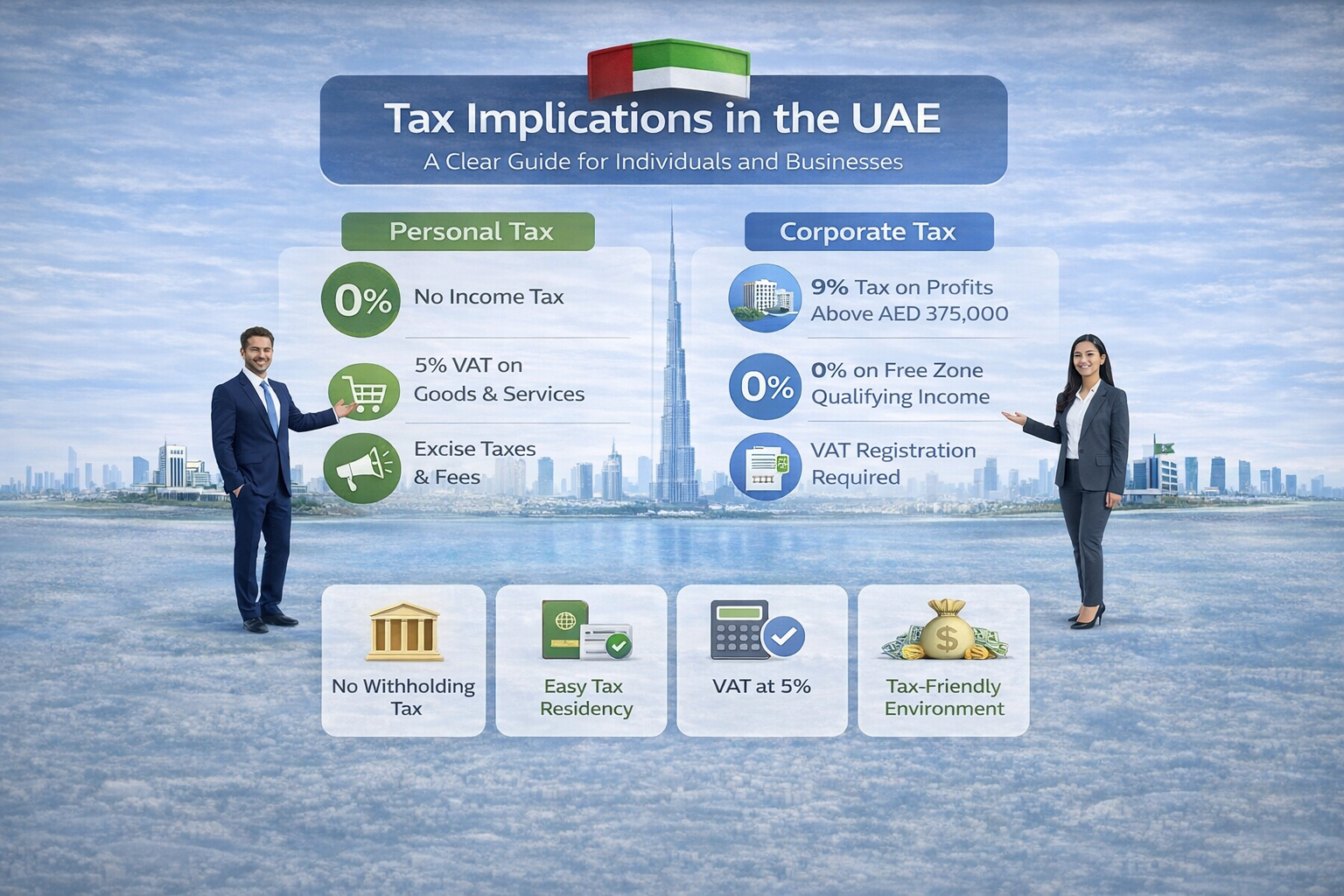
One of the UAE’s greatest advantages is that individuals pay no income tax. Salaries, freelance earnings, investment income, dividends, rental income (except emirate-specific housing fees), and capital gains are all exempt. There is no wealth tax, inheritance tax, or social security tax for expatriates.
Residents do, however, encounter other forms of taxation: VAT at 5% on goods and services, excise tax on specific products, and municipal housing fees. These are indirect taxes, and they do not affect personal income.
Corporate Tax: Understanding the 9% Regime
In June 2023, the UAE introduced Corporate Tax, positioning itself in line with global standards while maintaining attractive rates.
Corporate Tax applies to Mainland companies, Free Zone companies, and foreign entities earning UAE-sourced income. The system is simple: profits up to AED 375,000 are taxed at 0%, and profits above that threshold are taxed at 9%.
Companies must maintain proper accounting records, file annual tax returns, and in many cases, prepare audited financial statements.
Free Zones and the 0% Corporate Tax Regime
Free Zones can offer a significant tax advantage — but not all Free Zone income qualifies for the 0% rate.
To benefit, companies must demonstrate substantial presence in the free zone, meet activity requirements, and avoid excluded sectors such as banking or insurance. They must also comply with transfer pricing rules and maintain accurate reporting.
Income that qualifies for the 0% rate is known as “Qualifying Income,” which typically includes business with foreign clients or customers within the Free Zone.
If a Free Zone company earns income from the UAE Mainland without the proper structure, that income is taxed at 9%.
VAT: Universal for Goods and Services
Value Added Tax at 5% applies to most transactions in the UAE. Companies must register for VAT once their taxable supplies exceed AED 375,000 per year. VAT compliance requires quarterly or monthly filings, depending on business size.
No Withholding Tax
The UAE does not impose withholding tax on dividends, royalties, interest, or service fees. This makes the country attractive for international business structuring and cross-border operations.
Tax Residency Rules
Individuals can obtain a UAE Tax Residency Certificate by meeting residency requirements and providing supporting documentation. Companies can also secure tax residency status by demonstrating management and control, substance, and commercial activity in the UAE.
Final Thoughts
The UAE continues to offer one of the most favourable tax environments worldwide. Personal income remains tax-free, corporate tax is globally competitive, and Free Zone incentives support international business structures. Understanding corporate tax thresholds, Free Zone regimes, and compliance requirements ensures businesses remain tax-efficient while staying aligned with UAE regulations.