Why There Is Such a Big Gap in Information in Dubai’s Company Setup Space
12/8/2025
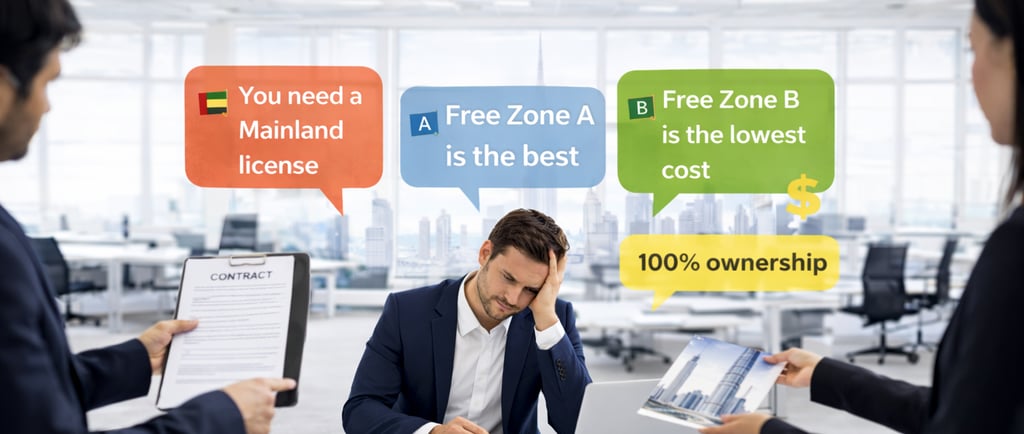
Setting up a company in Dubai should be a straightforward process, yet most entrepreneurs quickly discover that the information available online or from service providers is anything but consistent. One consultant says you need a Mainland license, another insists a specific free zone is the “best,” and a third offers a price that seems too good to be true. This fragmentation of information leaves founders feeling overwhelmed and unsure whom to trust.
The reality is that the UAE business setup market has grown so rapidly — and so competitively — that it has outpaced the standardization of information. What should be a regulated, transparent process often becomes a maze of conflicting advice. Understanding why this gap exists is the first step toward navigating the system with clarity.
The Oversupply of Corporate Service Providers (CSPs)
Over the past decade, demand for business incorporation in Dubai has exploded. In response, the number of Corporate Service Providers (CSPs) has multiplied — ranging from large consultancies to boutique agencies, offshore call centers, and even independent freelancers positioning themselves as experts.
Because there is no uniform benchmark for the quality or depth of information a CSP must provide, every provider communicates the process differently. Some simplify the information to make the sale, others exaggerate benefits, and many skip critical elements such as compliance, substance requirements, and banking eligibility. This creates a landscape where two clients asking the same question may receive completely different answers depending on who they speak to.
Free Zone Partnerships Create Inherent Bias
One of the least-discussed reasons behind contradictory information is the commission-based model between CSPs and free zones. Most service providers are “channel partners,” meaning they are financially incentivized to push specific jurisdictions.
When a CSP earns a commission from Free Zone A, it becomes tempting — or automatic — to recommend it regardless of whether Free Zone B or a Mainland structure would serve the client better. This bias is almost never disclosed, and clients often assume they are receiving neutral advice when, in reality, they are receiving partner-driven advice.
This is why one CSP might insist that “your activity can only be done in this particular free zone,” while another says the exact opposite.
A Complex Licensing Landscape with Too Little Explanation
Dubai offers remarkable flexibility in how a business can be structured: Mainland, free zone, professional licenses, commercial activities, dual licensing options, and specialized zones for media, finance, trade, logistics, and technology. While this ecosystem is one of the UAE’s greatest strengths, it also adds complexity.
When the nuances of activities, permitted operations, office requirements, or visa allocations are not clearly explained, clients understandably become confused. What one provider labels as “the cheapest option” may turn out to be unsuitable once hidden compliance steps, banking challenges, or operational limitations surface.
Compliance and Banking Information Is Frequently Omitted
Perhaps the biggest contributor to the information gap is the lack of upfront discussion around compliance and banking. Many CSPs focus solely on “getting the license issued” — because that is what they are paid for. Yet, the real challenges for business owners begin after incorporation.
Banking requirements in the UAE have tightened significantly. Banks examine factors such as the business activity, the shareholder’s background, the physical office, the company’s substance, and financial projections. Not every free zone or license type carries the same risk rating. When these details are not explained during the setup stage, clients face unexpected delays or even bank account rejections.
What appears to be simple marketing language — “100% ownership,” “fast setup,” “no office required,” “guaranteed bank account” — often hides the operational realities.
Marketing Has Outpaced Regulation
Because the UAE is a globally attractive destination, the business setup industry is highly competitive. Marketing campaigns try to capture clients quickly, sometimes oversimplifying the process into catchphrases and incomplete explanations. This has resulted in an “information marketplace” rather than a standardized, regulated environment.
Clients are left comparing contradictory claims, unsure which version reflects actual policy and which is simply a sales hook.
How to Navigate the Information Gap
The solution is not to rely on more information — but on the right information.
Entrepreneurs should look for consultants who offer transparent jurisdiction comparisons, explain banking requirements before incorporation, and do not limit their recommendations to only the free zones they partner with. Independent advice is essential in a market where incentives often shape the narrative more than client needs.
Final Thoughts
The information gap in Dubai’s company setup landscape is not due to a lack of available knowledge — it is due to the overwhelming volume of inconsistent, sales-driven, or incomplete guidance circulating in the market. By understanding the structural reasons behind these discrepancies, business owners can avoid common pitfalls and move forward with confidence. A clear, unbiased advisory approach can transform a confusing landscape into a streamlined and strategic process.